Power Quality Issues
Harmonic pollution is, as the name suggests, contamination of the electricity supply. Harmonic pollution caused by LED lighting, IT equipment, or industrial machines is a common issue that requires additional attention.
Harmonic filter
Solving harmonic pollution can be done, for example, by using a harmonic filter, also known as a mains filter. A harmonic filter helps to eliminate harmonics, optimizing the performance of your electrical equipment. By applying a mains filter, you can minimize the effects of harmonic pollution caused by LED lighting and other sources, resulting in greater efficiency and therefore a lower impact on grid congestion, fewer disruptions, and a longer lifespan of your equipment.
In our white papers ‘Higher harmonics’ and ‘Active dynamic filtering’, you can read everything about harmonic pollution, how it arises, what it is, and of course how you can resolve it.

What are power quality issues?
Power quality issues is a broad term referring to all unwanted electrical signals and disturbances within an electrical network. This can take various forms, such as voltage dips, flicker, and electromagnetic interference. It is a general term for anything that can disrupt the quality of electricity, or Power Quality, within an electrical network.
Harmonics
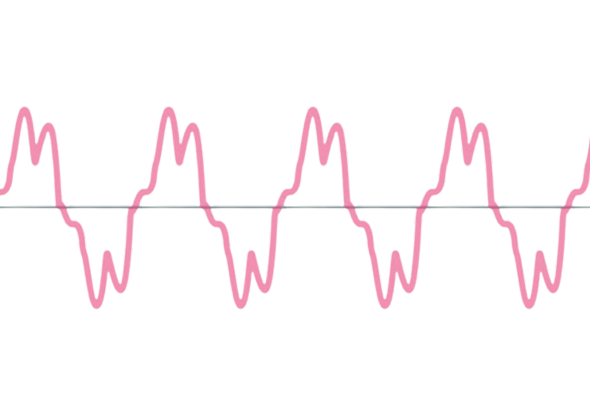
Within power quality issues, the previously mentioned harmonics are a specific type of disturbance. They arise when electrical equipment draws non linear current, leading to distortion of the current waveform. Instead of a pure sine wave, additional frequencies appear on top of the fundamental frequency. These additional frequencies are called harmonics and can cause various problems, such as overheating of equipment, loss of efficiency, and malfunctions. It is comparable to adding unwanted background noise to a pure musical tone, disrupting the original melody and creating undesirable effects.
Controlling harmonics is important to ensure that electrical systems continue to operate properly and efficiently.
Why solve power quality issues?
Power quality issues pose a significant threat to the efficiency and reliability of electrical systems. When electrical power is contaminated by unwanted signals and disturbances, such as reactive power and harmonic distortion, this can lead to a wide range of problems. Equipment that is sensitive to power quality, such as IT equipment, medical equipment, and industrial machines, may become damaged or operate less efficiently. This results not only in higher energy costs, but also in increased maintenance and replacement costs.
Shorter lifespan
Another major disadvantage of power quality issues is that they can significantly shorten the lifespan of equipment. Due to constant exposure to distorted power, components can overheat and wear out more quickly. This leads to frequent malfunctions and unexpected downtime, seriously disrupting productivity and business continuity.
Safety risks
We may not always realize it, but power quality issues can also lead to safety risks. Overheated equipment can create a fire hazard, and failures in critical systems can cause dangerous situations, especially in environments such as hospitals or industrial facilities.
In short, resolving power quality issues is essential to safeguard the performance, lifespan, and safety of your electrical systems. By improving the quality of your power supply, you can not only reduce costs, but also increase the reliability and safety of your organization.


How to solve power quality issues?
One of the most effective ways to resolve power quality issues is by using a harmonic filter. These filters are designed to eliminate unwanted harmonics and other electrical disturbances, significantly improving the quality of the power supply. By installing a harmonic filter, you ensure a more stable and cleaner power supply, resulting in better equipment performance and fewer malfunctions.
Active dynamic filter
A more advanced solution is the use of an ADF (Active Dynamic Filter). An ADF is an active filter that can respond in real time to changing electrical loads and disturbances. This type of harmonic filter automatically adapts to conditions and provides a highly efficient way to minimize power quality issues. The dynamic nature of an ADF makes it particularly effective in environments where the electrical load constantly varies, such as industrial installations or buildings with many different types of electrical equipment.
By using an ADF, you can address a wide range of disturbances and optimize power quality. This not only results in a longer lifespan for your equipment, but also in higher reliability and lower energy costs. Implementing these solutions is an important step toward a stable and efficient electrical system.
Request your white paper ‘Active dynamic filtering’ here! Ask your question
